
Hey travelers, looking for information and photos about India Pavilion Venice Biennale 2026? You're in right place.
After seven years of absence, the India Pavilion returns to the 61st Venice Biennale with a quietly powerful exhibition that redefines what home means in a changing world. Titled Geographies of Distance: Remembering Home, this national pavilion of India at the Venice Art Biennale 2026 brings together five artists working with soil, thread, bamboo, and papier-mâché to explore memory, migration, and belonging on one of art's most visible platforms.
Let's find out in this complete post by Venice Insider Guide about India Pavilion, Venice Biennale 2026.
India Pavilion Venice Biennale 2026 Return to Venice: Context and Concept
India returns to the Art Biennale after seven years with an official India Pavilion Venice Biennale 2026 that signals renewed cultural confidence and diplomatic intent. Within the broader history of La Biennale di Venezia, India's participation has been intermittent - making this moment both a proud moment for Indian art and a strategic repositioning on the global stage.
The Indian Pavilion appears at the 61st Venice Art Biennale aligned with the main exhibition's theme, In Minor Keys, curated by Koyo Kouoh. Yet it carries its own distinct project title: Geographies of Distance: Remembering Home. Where the Biennale's overarching theme emphasizes minor keys - subdued tones, spiritual resonance, interiority - the India Pavilion at the Venice Biennale 2026 brings its own narrative of plurality, displacement, and material memory.
India's return underscores a new model of cultural diplomacy. The Ministry of Culture leads the project as official presenter, with the government partnering private institutions including NMACC and the Serendipity Arts Foundation to produce the exhibition, public programs, and a broader ecosystem of engagement. This mixed patronage reflects the evolving realities of how a country presents its creative communities internationally.
The conceptual frame treats home not as a fixed geography but as a portable condition - an emotional space carried within the self, shaped by migration, ritual, and transformation. Curator Amin Jaffer explores cultural identity through personal mythologies and memories, drawing on his own diasporic background to articulate how distance from home can be felt even by those who never left. Previews run 6–8 May 2026, with the public opening on 9 May and closing on 22 November 2026, all within the Arsenale complex in Venice.
Geographies of Distance: Remembering Home – Exhibition Overview
Geographies of Distance: Remembering Home positions home as material memory rather than postal address. The exhibition explores home through memory, material, and movement - treating belonging as something assembled, lost, and rebuilt across time and distance. Home appears not as a destination but as an idea continually negotiated through labor, care, and remembrance.
The raw Venetian interiors of the Arsenale - exposed brick, maritime patina, high weathered ceilings - serve as a deliberate backdrop. Rather than a polished white cube, the venue's own traces of age, decay, and layering mirror the fragile domestic structures and changing landscapes within the works. The exhibition draws connections between physical and emotional experiences of home, linking Indian architectural histories (terracotta, bamboo, threadwork, papier-mâché) with Venice's own story as a port city shaped by trade and tides.
Core themes include:
- Home as an emotional condition reshaped by urban transformation and ecological change in India
- The tension between rapid development and intimate domestic life in contemporary India
- Migration, return, and the distance felt by diaspora and internal communities alike
- Material traditions as carriers of belonging - part ritual, part personal mythology, part material testimony
The five artists are installed so their works speak across the space: transitions from soil and clay to thread and suspended forms, from tight architectural clusters to open participatory structures. Dim natural light, shadows cast by suspended sculptures and bamboo frameworks, and pathways that physically guide visitors through differing emotional registers create a deeply personal journey.
The Five Artists of the Indian Pavilion Venice Biennale 2026
The Indian Pavilion Venice Biennale 2026 features five artists from diverse regions of India - spanning rural Tamil Nadu, New Delhi, Bangalore, Hyderabad, and Ladakh - forming a cross-generational, cross-regional group mapping contemporary India through material and memory. Together, they present a portrait of a country grounded in local practices but responsive to global questions of migration, belonging, and climate change.
The five artists are:
- Alwar Balasubramaniam - earth and soil as foundations
- Sumakshi Singh - ghostlike thread architectures
- Ranjani Shettar - suspended organic forms
- Asim Waqif - participatory bamboo structures
- Skarma Sonam Tashi (Sonam Tashi) - Ladakhi settlements from recycled matter
Each artist offers a different entry point to home. Their practices reflect deep engagement with earth, architecture, craft, and ecological thinking, using artists' traditional materials deeply rooted in Indian civilization to forge innovative forms that engage meaningfully with the world.
India Pavilion Venice Biennale 2026 - Alwar Balasubramaniam: Earth as Home
Alwar Balasubramaniam centers his practice on elemental forces - earth, water, wind - drawing on terracotta traditions from South India.
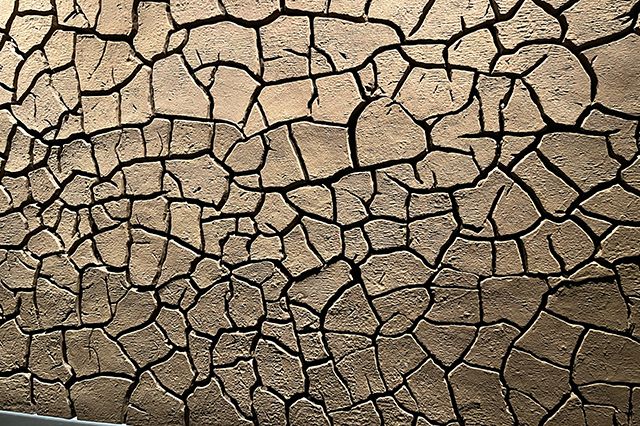
In the India Pavilion at the Venice Biennale 2026, he presents sculptural panels sourced from soil and clay of rural Tamil Nadu, their surfaces marked by fissures and natural textures that suggest both vulnerability and endurance.
The works blur boundaries between sculpture, wall, and floor. Visitors feel as if walking through an excavation of memory: cracked surfaces, compacted earth, faint pigment layers, and the faint smell of clay. Earth and soil act as archives, holding traces of migration, labor, and care. The land beneath our feet becomes a terrain of India's material history - always shifting under environmental and social pressures, yet stubbornly present.
Sumakshi Singh and Ranjani Shettar: Thread, Suspension, and Handmade Time
This section pairs two artists who both work with lightness, suspension, and hand-driven processes to evoke volatile memories of home - yet whose vocabularies could not be more distinct.
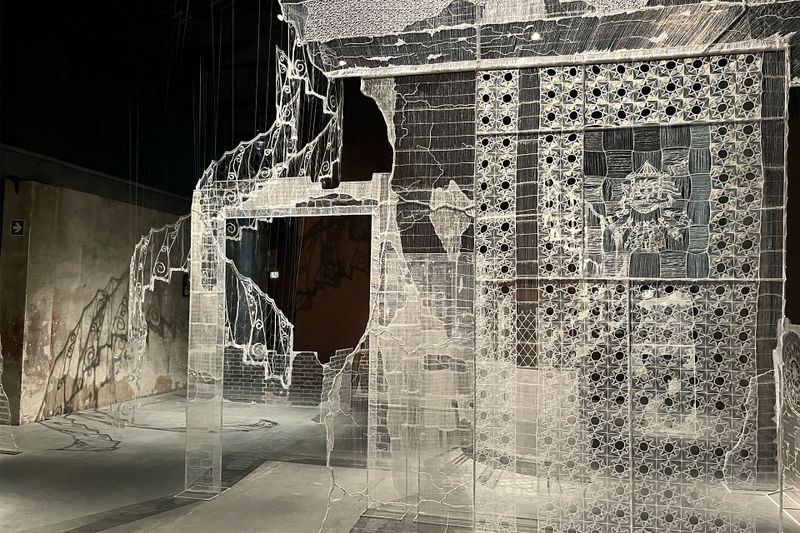
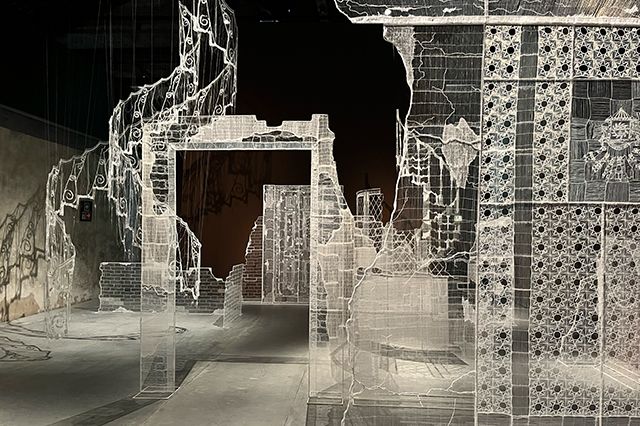
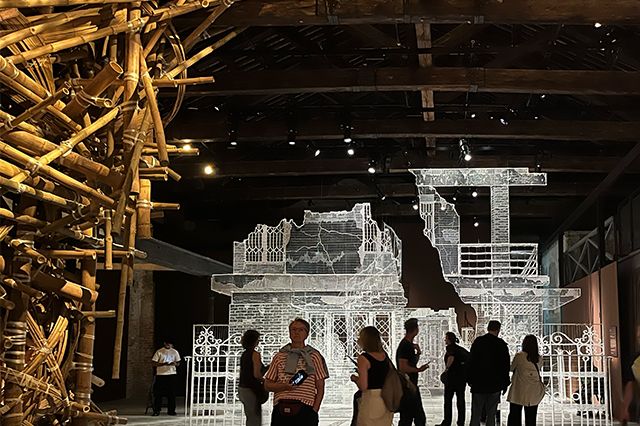
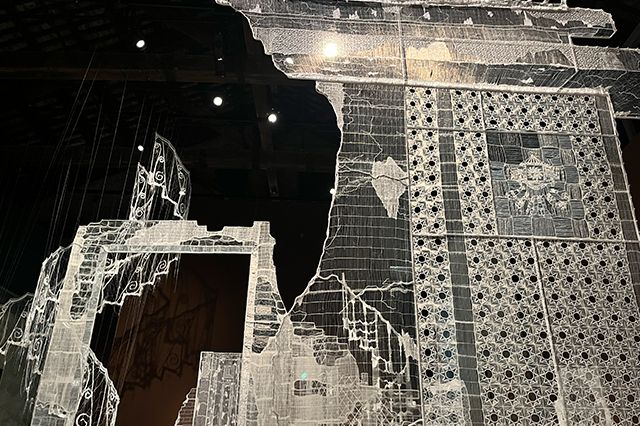
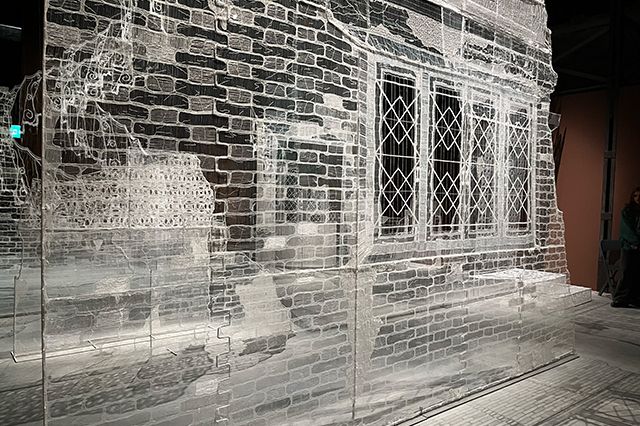
Sumakshi Singh reconstructs her demolished family home entirely in thread. Her installation, Permanent Address, reimagines fragments of her New Delhi residence at 33 Link Road - doors, windows, staircases, balconies - as translucent, walk-through architectural drawings suspended in embroidered thread and delicate frameworks. The work demonstrates how absence can become its own physical presence. Singh's architecture is porous and intangible, yet maps domestic space from memory with startling precision, turning demolition into an act of devotion. Sumakshi Singh's work reconstructs her demolished family home in thread, making the idea of a permanent address both deeply personal and universally resonant.
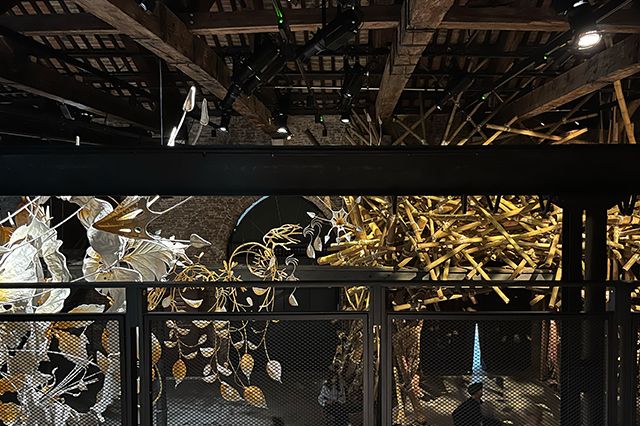
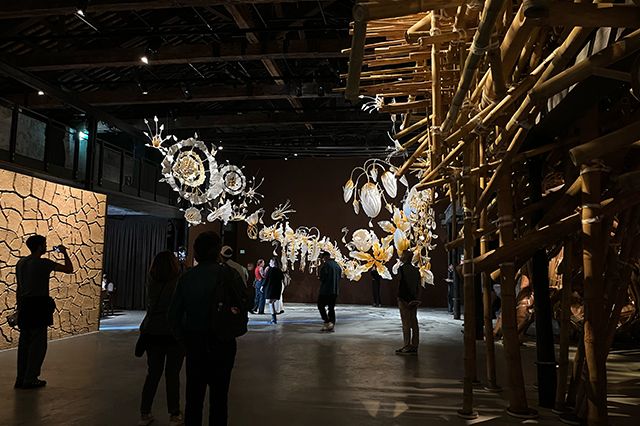
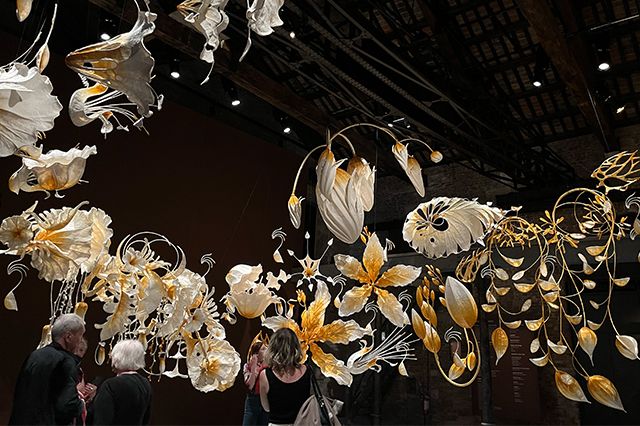
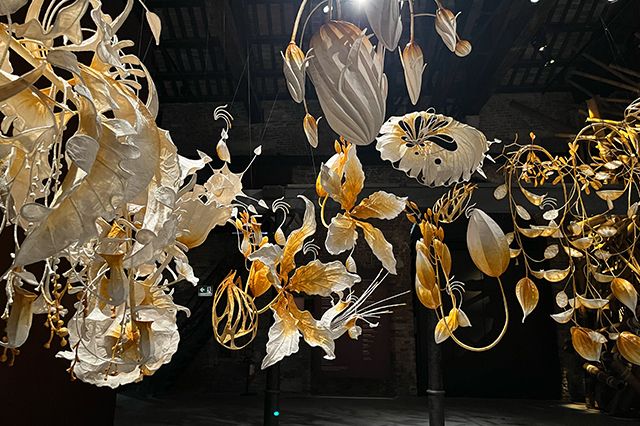
By contrast, Ranjani Shettar's sculpture features hand-formed organic shapes - recalling seed pods, flowers, or marine life - suspended from the ceiling under the same sky of the Arsenale. Ranjani Shettar's work explores natural materials and craft processes, with pale amber surfaces that catch Venetian light and cast moving shadows. Her slow, hand-driven processes embody handmade time, suggesting that home is built and rebuilt through repetitive gestures rather than static blueprints. Each work demonstrates how India's creative talent continues to speak through craft traditions that feel both ancient and urgently present.
Asim Waqif and Skarma Sonam Tashi: Architecture, Ecology, and Participation
The pavilion's most overtly architectural and ecological works come from Asim Waqif and Skarma Sonam Tashi, whose installations address what happens to home when the ground itself shifts.
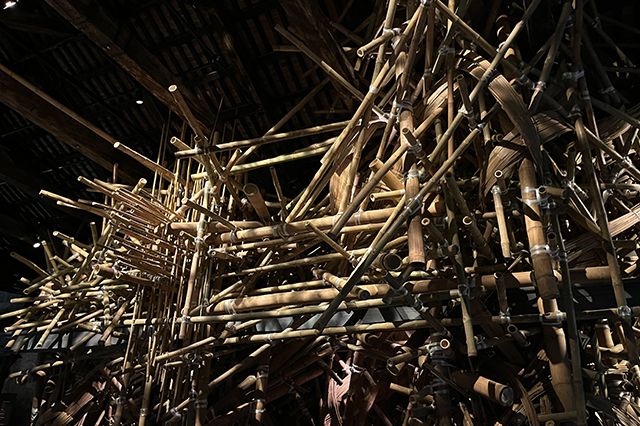
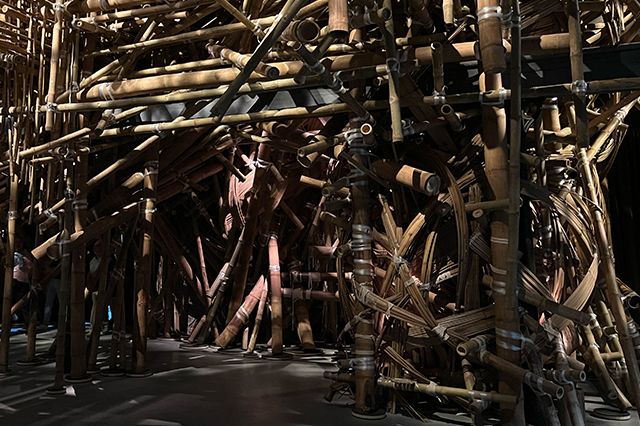
Asim Waqif's installation is made from dense bamboo structures - a large-scale framework titled Chaal that references the ubiquitous scaffolding of Indian cities. Trained in architecture, Waqif uses repurposed bamboo, timber, and waste to create interactive frameworks visitors can move around and sometimes through. The structure feels provisional and alive, creaking subtly with movement. Asim Waqif's installation suggests home as assembled through use and repair, turning domestic architecture into a system held together by negotiation rather than permanent walls.
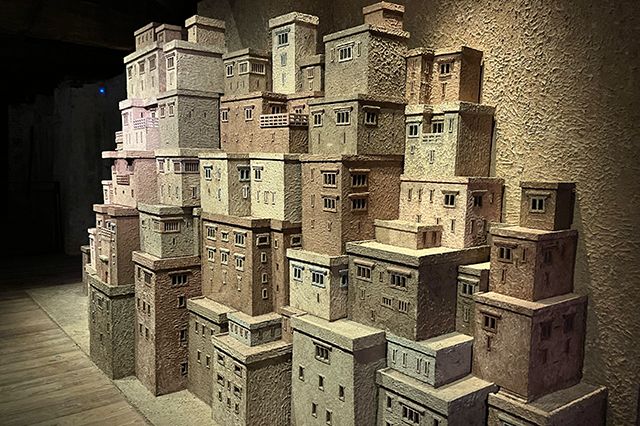
Skarma Sonam Tashi's work uses recycled materials and traditional techniques to evoke Ladakh's high-altitude settlements. His sculptural installations - compacted, terraced forms made from papier-mâché and reclaimed matter - recall traditional architecture shaped by harsh climate and scarce resources. Sonam Tashi highlights a key motif: a large, cracked wall reading at once as fragile boundary, eroding glacier, and cultural memory under stress. The work points to ecological change in the Himalayas and its impact on creative communities whose homes are literally dissolving. The contrast between Waqif's participatory bamboo networks and Tashi's clustered, seemingly static but internally vulnerable structures ties both clearly to geographies of distance.
Curatorial Vision and Contemporary India Pavilion Venice Art Biennale
Dr. Amin Jaffer, born in Rwanda into an Indian merchant family, brings a museum background and deep interest in how objects carry histories of trade, empire, and domestic life. His curatorial approach frames the India Pavilion around distance, migration, and the emotional weight of home - aligning with Biennale Arte 2026's theme of minor keys while giving India a distinct narrative voice.
The exhibition reflects contemporary India as plural, layered, and in flux - a country of megacities, small towns, and remote regions all negotiating transformation. Rather than a single image of India, the curatorial vision resists monolithic narratives. Cultural diversity becomes structural principle, not decoration. The pavilion's presentation positions Indian artists within global contemporary art discussions on ecology, identity, and the politics of space.
Institutional partners play defined roles: the Ministry of Culture serves as official presenter with the government coordinating national interests, while NMACC and Serendipity Arts Foundation contribute to production and public programs. Programming extends beyond static display through performances, conversations, and temporary activations - including classical music presented during the vernissage and site-responsive events across Venice. India affirms through this pavilion that cultural confidence on the global stage requires sustained investment, not occasional gestures.
India Pavilion, Venice Biennale 2026: Practical Information for Visitors
- Dates: Previews 6–8 May 2026; public opening 9 May; closing 22 November 2026
- Location: Arsenale complex, Venice, within the cluster of national pavilions
- Tickets: Access via the general Biennale ticket - no separate ticket for the India Pavilion Venice Art Biennale 2026
- Suggested visit time: Allow 30–45 minutes to experience the immersive installations and spatial transitions
- Public programs: Talks, performances, and activations curated by Serendipity Arts Foundation and partners on selected dates; check the official India in Venice and Biennale websites for the latest schedule
- Getting there: Visitors can reach the Arsenale via signposted routes from key vaporetto stops including Arsenale and Giardini
FAQ
Who organizes the India Pavilion at the 61st Venice Biennale 2026?
The India Pavilion Biennale 2026 is presented by the Ministry of Culture, Government of India, in collaboration with the Nita Mukesh Ambani Cultural Centre (NMACC) and Serendipity Arts Foundation. Dr. Amin Jaffer serves as curator, bringing a background in museum collections and diaspora studies to the project.
Where exactly is the India Pavilion located in Venice 2026?
The India Pavilion Venice 2026 is housed in the Isolotto warehouse within the Arsenale, one of two main exhibition venues of La Biennale di Venezia. Visitors can reach it via the Biennale's signposted routes from vaporetto stops at Arsenale and Giardini.
Do I need a separate ticket to visit the India Pavilion, Venice Biennale 2026?
No separate ticket is required. Entry to the India Pavilion Venice Biennale 2026 is included in the standard 61st Venice Biennale ticket, which covers both the Arsenale and Giardini exhibition areas.
Why is India's return to Venice significant?
India's return with an official national pavilion after a seven-year absence signals renewed commitment to presenting contemporary India on one of the world's most influential art stages. It strengthens cultural diplomacy and gives Indian artists sustained visibility in global debates on migration, ecology, and identity - making it more than a proud moment for the art world.
What makes the India Pavilion 2026 different from previous presentations of Indian art abroad?
Geographies of Distance: remembering home foregrounds process, material memory, and collaboration between public and private institutions. Rather than surveying canonical names, the Indian Pavilion Venice Biennale 2026 brings together five artists whose practices reflect deeply rooted engagement with organic materials and site-specific approaches, offering an immersive portrait of contemporary India's evolving realities rather than a single curatorial statement.
India Pavilion, Venice Biennale 2026: Conclusion
The India Pavilion is the official national pavilion at the 61st Venice Biennale 2026, titled Geographies of Distance: Remembering Home, running from 9 May to 22 November 2026 at the Arsenale complex in Venice.
India's return after a seven-year gap is curated by Dr. Amin Jaffer and presented by the Ministry of Culture, Government of India, with the Nita Mukesh Ambani Cultural Centre (NMACC) and Serendipity Arts Foundation as partners.
Five artists - Alwar Balasubramaniam, Sumakshi Singh, Ranjani Shettar, Asim Waqif, and Skarma Sonam Tashi - use organic and traditional materials deeply rooted in Indian civilization to map contemporary India through personal and collective memory.
The India Pavilion Venice Biennale 2026 features immersive installations housed in the raw Venetian interiors of the Arsenale, where clay, soil, thread, bamboo, and recycled matter express geographies of distance remembering home as an emotional condition rather than a fixed place.
Follow us Venice Insider Guide!
- The photos in this article of the India Pavilion Venice Biennale 2026 are the property of Venice Insider Guide.